
RULES OF PLAY & CONDUCT
All players are responsible for knowing the rules. Most importantly, all players have a very important role with respect to the spirit of the game. We are a recreational association and not a professional league. Our goal is for all players to be involved, feel supported by their teams and opponents and have fun.
1. We will adhere to the SPN rule book for all rules that are not outlined in the following Bridge City Slo-Pitch League rules.
2. Be sure that you will be fielding a full team each week. Especially for the first few games, it is a good idea for the team captain to contact players to cover off field location, their attendance, and being on time (at least 15 minutes early). Thereafter, the players should contact their captains a few days in advance if they are going to miss a game. This gives you time to call in some substitutes.
3. Be as friendly, accommodating and helpful as possible in dealing with your opponent. Before the game, introduce yourself and shake hands. Cover off any potentially arguable areas. During the action, if a dispute arises, settle it quickly and amicably.
4. Respect other people’s property. Broken windows, dented cars and any other damage caused by teams during play MUST BE REPORTED. We are adults who are responsible for our actions, however, unintentional.
5. Respect the rule of law. Public drinking, urinating, littering, etc. is ILLEGAL. Govern yourselves accordingly and maintain the reputation of all of our teams. Enjoy yourselves and be discrete.
6. Post game- Three Cheers! Shake hands. Go somewhere and quench your thirst.
THE GAME
a) League nights consist of two 5 inning games which may end in tie scores. The Mercy Rule can end a game if one team is up by more runs than their opponent can score in their remaining at bats (i.e. 10 bats per inning).
b) The team listed as the home team will bring bases and be Home Team in the first game. In the second game the teams switch who is home and visitor. This way each night both teams have a chance to be the home team.
c) The team that is at bat supplies an umpire for their side of the inning.
d) Each team’s inning at bat will end after three outs or after the tenth batter, this includes the last inning of play.
e) Rain Out Policy – On rainy days or if fields are not dry from previous days rain it is up to each team captain to contact the opposing teams captain to postpone the game. Do not just assume the game is postponed, make the effort to contact the other team. This initial contact will also start the conversation for a possible make up day. All make up games are the responsibility of the affected teams. The league will assist as needed.
FIELDING A TEAM
a) A full team is 10 players (4 outfielders, 4 infielders a catcher and a pitcher).
b) No more than 7 males may take the field during any inning.
c) Games start at 6:30pm. There is a 10 minute grace period to allow for the minimum players needed to arrive or the team that is short players will default.
d) If a team is short players, it could field a team without default by fielding at least 8 players (one less infielder and outfielder). The batting order will still be filled out with ten batters and an automatic out is called each time an absent player’s turn comes up.
Note: At its sole discretion, the other team may agree to provide a catcher, thus allowing an 8 or 9 player team to have 4 infielders. This supplied catcher is an active player, fielding all balls as a player of the opposing team.
e) Automatic default occurs when- At 6:40 pm, less than 8 players are ready to start. A team cannot start with less than 2 females.
In the event of a default, the score will automatically be 15-0. Note: Should a team know that some players will arrive late, it is up to the two captains to decide to default and play for fun, or to scrimmage until the players arrive.
PREPARING FOR PLAY
THE HOME TEAM IS RESPONSIBLE FOR PEPARING THE DIAMOND AS FOLLOWS.
a) The 36” X 24” strike plate is placed directly behind home plate. No cut outs.
b) Bases are set securely twenty paces (60ft) apart from each other, as close to square as possible. First base safety bag is to be set with the orange half in foul territory, white half in fair territory. Pitcher is to stand between 50 – 65 ft away from home plate when pitching.
c) A commitment line is clearly marked halfway between third base and home plate.
d) Foul lines and out of play lines are pointed out to the opposing captain.
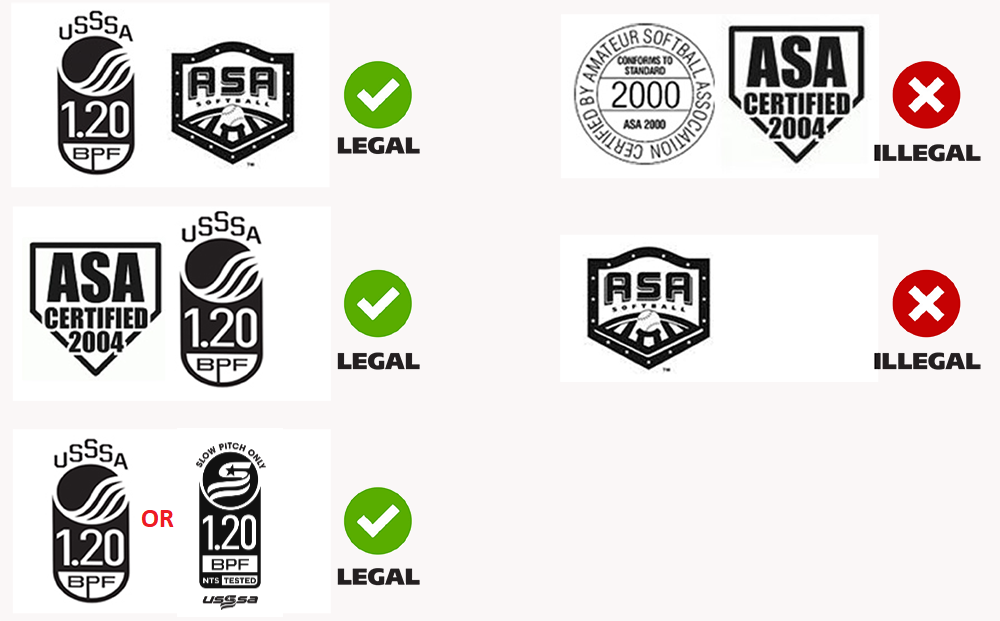
e) All bats are checked for SPN approval. Using a banned bat results in the batter being called out. All USSSA 1.20 BPF bats with compliance stamp are approved for play.
f) Score sheets are to be filled out. Girls are to bat in positions 3, 6 and 9. If your order consists of more than 3 girls the extras can be placed wherever.
PLAYING THE GAME IN THE FIELD
WHEN YOUR TEAM TAKES THE FIELD, MOVE TO YOUR POSITION QUICKLY AND BE READY WITH A BALL IF YOU WANT ONE MINUTES THROWING PRACTICE. PITCHERS SHOULD KEEP THEIR WARMUPS TO A MAXIMUM OF TWO MINUTES BEFORE CALLING BATTER UP.
a) Standard pitching rules apply. The pitch must arc between 6 feet (generally, if its over the batters head it is high enough) and 12 feet or it will be deemed a no pitch (ball).
b) If the ball arcs less than 6 feet or more than 12 feet it is a No Pitch and it is considered a ball. Umps must call No Pitch as early as possible. If the batter swings, then the ball is in play and the pitch counts. A strike occurs on a foul ball or a swing and a miss.
c) A strike is any pitch that contacts the strike board.
d) WALKS- the batter is given first base if they see four balls in their at bat, IF THE BATTER SEES FOUR STRAIGHT BALLS TO START THEIR AT BAT, THEY ARE GIVEN SECOND BASE.
e) A play stops when the ball is returned to the pitcher on the mound or ends up out of play.
f) When the batting team’s tenth batter is up, there are no walks. The fielding team returns the hit ball to the catcher who touches home plate, ending the inning. If the ball goes out of play prior to reaching home plate all runners on base score.
g) If a defending player is injured while play is in progress, the pitcher calls Time and all play must stop.
h) OVERTHROW is a ball thrown from one fielder toward another and for whatever reason, goes into “out of play territory”. If this occurs, all baserunners will be awarded two bases from the last base touched at time of the throw.
i) INFIELD FLY is a fairly batted fly ball (not a line drive) which can be caught by an infielder with ordinary effort when first and second, or when first second and third bases are occupied with less than two out. Any defensive player, who positions himself within the field area, will be considered an infielder for the purpose of this rule.
j) There is no tagging a runner heading to first base. The fielder must touch the white half of first base while in control of the ball to make an out. Touching the orange half results in the runner being called “safe”.
k) There is no tagging a runner heading for Home after they pass the commitment line. A fielder must touch home plate and not the strike plate, while having control of the ball to make an out.
l) There is no tag required in any “force out” situation.
m) Fielders may not interfere with a runner legally running the bases unless they are in possession of the ball, fielding a batted ball, executing a play or catching a thrown ball. If obstruction occurs the Umpire will call it and the runner will advance to the next base, forcing any runner ahead of him/her to their next base.
n) Teams may switch pitchers before but not during any at bat.
PLAYING THE GAME AT BAT
WHEN YOUR TEAM IS AT BAT, KNOW YOUR PLACE IN THE LINE-UP AND BE READY AND AT THE BACKSTOP WITH YOUR BAT WHEN YOU ARE ON DECK
a) Bunting or chopping the ball down is not allowed.
b) A foul ball is one that lands or rolls to the outside of the 1st or 3rd base path before it passes these bases OR lands outside the foul line after passing 1st or 3rd base OR hits the strike plate. A ball off of home plate is a fair ball.
c) All foul balls not legally caught are called strikes, including the third strike. If a foul ball / third strike is called, batter is out.
d) Foul tip rule – ANY foul tip legally caught by the catcher is an out. It does not have to be over the batters head or a third strike.
e) If a batter steps across or on the strike plate to attempt to hit a ball it is an automatic out.
f) A team’s 10th Batter in one inning must be announced prior to their first pitch or the inning is over.
g) If a fielding player is injured while the play is in progress, all play must stop. Runners will advance to the base they were heading toward when Time was called by the pitcher.
h) Runners stopping at first base may only tag the orange half of the bag. Runners proceeding past first base may only touch the white bag on the way to second.
i) Runners who pass the commitment line between 3rd base and home must continue home.
j) COURTESY RUNNERS – A maximum of five (5) courtesy runners per game may be used but the same baserunner cannot be used more than once. Where a courtesy runner is used a male must be placed for a male or a female for a female. Exception For Females Only – Once all available females have been used as baserunners they may be used again.
k) There is no leading off. Runners may only leave their base after the ball is contacted by the batter. On a swung on and missed pitch strike, a runner who leads off is out. The runner should not wait for the umpire to make this call. If you lead off head to the bench and call yourself out.
l) On fly balls, including in play foul balls, base runners can tag up and go, leaving their bag only after the ball is caught.
m) Sliding is only allowed at second and third base. There is no safe overrun of second or third base.
n) Runners must pass behind the Strike Plate at home to score a run.
o) Base runners must remain within 10 feet of the base paths in any attempt to avoid a tag. They will be called out if they leave this area.
p) Runners may not interfere with a fielder trying to make a play. The lead base runner will be called out if any interference is called.
q) If you swing at a called No Pitch and miss it, it is called a strike.
r) You may not switch hands in the middle of an at bat.
s) HOME RUN RULE applies only to diamonds with fences. Each team is allowed two home runs over the fence per inning. If a third home run is hit over the fence the batter is out and play is dead.
UMPIRING
UMPING IS A NECESSARY PART OF OUR GAME. EVERY PLAYER SHOULD TAKE A TURN AT UMPING AND RECEIVE THE SAME RESPECT AS HE/SHE WILL GIVE THE NEXT UMPIRE. THE LEVEL OF RESPECT YOU RECEIVE CAN DEPEND ON YOUR KNOWLEDGE OF THE RULES AND YOUR ATTENTION TO THE GAME IN PROGRESS. WHEN YOU ARE UMPING, MAKE YOUR CALLS QUICKLY AND LOUDLY TO AVOID UNNECESSARY ARGUMENTS AND POTENTIALLY DANGEROUS UNECESSARY EFFORT (EXAMPLE: A FIELDER DIVING TO CATCH AN OUT OF PLAY FOUL BALL).
a) Umpires are responsible for all of the following:
- Keeping track of balls and strikes for each at bat
- Announcing how many outs before each new batter
- Announcing 10th batters before they beginning their at bat
- Calling safe and out at each base
- Calling hit balls fair, foul, out of play, or infield fly
- Calling thrown or booted balls out of play (dead ball)
- Calling no pitches
- Calling lead offs on base runners
- Calling interference on the base paths
- Moving into the proper position to make these calls
b) All players in a game have a responsibility to everyone involved to contribute honest information. For example, if a runner leads off or misses a bag and the umpire is unaware, a fielder may inform the umpire if the runner doesn’t come clean about it. In sliding situations, it is usually very difficult to make a clear call. The honour system must apply between runner and tagger.